
Electrical hazards in the industrial workplace are a serious concern that should not be taken lightly. From exposed wiring to overloaded circuits, these hazards pose significant risks to both employee safety and a business’s overall productivity. OSHA’s electrical standards are designed to protect employees exposed to these dangers and to prevent accidents, injuries, and fatalities.
The Importance of Electrical Safety in the Workplace
Ensuring electrical safety is paramount to protect employees from potential hazards such as electric shock, electrocution, fires, and explosions. OSHA plays a crucial role in establishing and enforcing standards to safeguard workers in relation to electrical equipment and systems.
Their electrical standards encompass various aspects of electrical safety, including the safe examination, installation, operation, and maintenance of electrical equipment. These standards connect directly to the General Duty Clause, which requires employers to provide a workplace free from recognized electrical hazards, even those not explicitly detailed in a specific subpart.
Common Electrical Hazards and Technical Corrective Actions
A safe working environment begins with hazard recognition. Below is a breakdown of common workplace hazards and the technical corrective actions required for compliance:
| Hazard | Industry Example | Corrective Action |
| Exposed energized parts | Missing panel covers or open junction boxes | Install proper covers and restrict access to qualified personnel. |
| Overloaded circuits | Multiple high-load devices on a single circuit | Redistribute load and verify circuit capacity meets demand. |
| Improper grounding | Ungrounded equipment or bypassed grounding pins | Verify grounding continuity and bonding for all enclosures. |
| Damaged insulation | Frayed conductors or cracked cable jackets | Replace damaged wiring or cables immediately: do not tape! |
| Missing knockouts | Open holes in electrical panels or boxes | Install approved fillers to maintain enclosure integrity. |
| Improper cord use | Permanent use of temporary extension cords | Replace with fixed wiring compliant with the National Electrical Code. |
| Wet conditions | Equipment used in damp environments | Install GFCI protection and use weather-rated enclosures. |
| Lack of labeling | Panels or disconnects not clearly identified | Apply durable labels per OSHA and NFPA requirements. |
OSHA’s Role and Referenced Consensus Standards
OSHA’s electrical standards are based on national consensus standards such as the National Electrical Code (NEC) and the Standard for Electrical Safety in the Workplace. While OSHA provides the legal mandate, these codes provide the technical roadmap for compliance.
- 29 CFR 1910 Subpart S: The primary OSHA regulation for electrical safety.
- NFPA 70E: The industry standard for safety-related work practices and arc flash protection.
- NFPA 70B: The standard for electrical equipment maintenance, which focuses on the “condition of maintenance” to ensure equipment is safe to operate.
For example, OSHA 29 CFR 1910.331-335 defines “Safety Related Work Practices” for qualified and unqualified workers, covering the scope, content, and application of electrical safety practices.
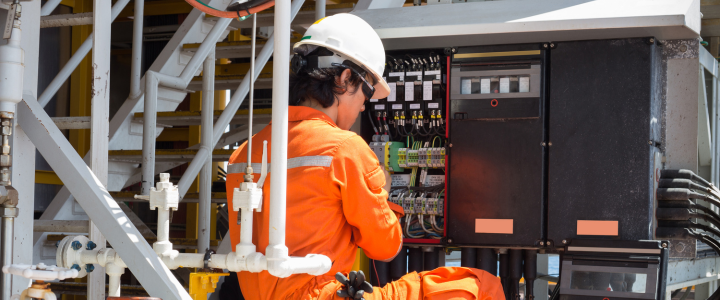
Comprehensive Standards for Electrical Equipment and Systems
Electrical Safety-Related Work Practices
OSHA requires employers to establish safety-related work practices and provide electrical safety training to employees working directly with electrical equipment. This includes procedures to prevent electric shock and the recognition of human error precursors like fatigue, rushing, or distractions that lead to incidents.
Electrical Equipment Inspection and GFCI Protection
Employers must regularly inspect electrical equipment to ensure it is properly working and defect-free.
- GFCI Requirements: Ground-fault circuit interrupters are mandatory in damp or temporary environments to prevent electrocution.
- Damaged Equipment: Any equipment found to be damaged or defective must be promptly removed from service and repaired or replaced.
Lockout/Tagout (LOTO) Procedures
OSHA requires using lockout/tagout procedures to control hazardous energy during the maintenance and repair of electrical equipment. These procedures help prevent unexpected energization or startup, protecting workers from electrical hazards.
Electrical Hazard Analysis and Arc Flash Boundaries
Employers must conduct an electrical hazard analysis to identify potential electrical hazards in the workplace. This analysis helps determine:
- Arc Flash Boundaries: The distance at which a worker could receive a second-degree burn.
- Approach Boundaries: Limited and restricted distances that dictate who can enter the area.
Personal Protective Equipment (PPE)
OSHA mandates the use of task-specific PPE based on the identified risks:
- ASTM D120 rubber insulating gloves: Rated by voltage class (Class 00 through Class 4).
- Arc-rated (AR) clothing: Flame-resistant clothing designed to protect against arc flash heat.
- Insulated hand tools: Rated for the specific voltage of the equipment being serviced.
- Eye and Face Protection: Including safety glasses and arc flash hoods for high-incident energy tasks.
Electrical Wiring, Clearance, and Equipment Design
Electrical wiring and equipment must be designed, installed, and maintained according to recognized industry standards.
- Working Space Clearance: OSHA requires a minimum working space of approximately 3 feet for equipment operating at 600 volts or less (1910.303(g)(1)).
- Design Integrity: This includes proper insulation, grounding, and protection against overloads and short circuits.
2026 Compliance: Penalties and Emerging Safety Technology
As of 2026, OSHA has adjusted maximum penalties for non-compliance to account for inflation. Serious violations now carry a maximum penalty of $16,131 per violation, while Willful or Repeated violations can exceed $161,323 per violation. Source: OSHA Violations Guide
To stay ahead of these risks, industrial leaders are adopting “Active Safety” technology:
- Wearable Voltage Detectors: Small sensors that alert workers when they move within a dangerous energized field.
- IoT Predictive Monitoring: Sensors that monitor real-time busbar temperatures to identify thermal runaway or potential faults before an arc flash occurs.
OSHA Electrical Standards Reference Table
| OSHA Standard | Scope | Requirement |
| 1910.303 | General requirements | Proper installation, mounting, and use of equipment |
| 1910.331-335 | Work practices | Training for qualified persons and safe work procedures |
| 1910.147 | Lockout tagout | Control of hazardous energy during equipment service |
| 1910.305 | Wiring methods | Requirements for grounded conductors and enclosure integrity |
Contact Safety By Design for OSHA Electrical Training in Houston, Texas
By following OSHA’s standards for electrical systems, employers can ensure that their employees are knowledgeable about safety-related work practices and can work safely with electrical equipment.
Safety By Design is a professional third-party safety consulting firm offering premier OSHA training services in Houston, Texas. We provide onsite safety audits, hazard assessments, and comprehensive training solutions offered online and in person.
Request a consultation today to learn more about our safety training solutions.
Thank you for visiting our website! We appreciate your interest in workplace safety. Please note that Safety by Design is not affiliated with OSHA. However, we can assist you with the following OSHA-related services:
- OSHA Mock Inspection
- OSHA Training
- Facilitate OSHA Inspections and Citations
If you need to file a complaint with OSHA, please call 800-321-6742 (OSHA) or visit this page for other methods to contact them.