
OSHA does not give every employer the same first aid kit supply list. It requires adequate supplies that employees can reach quickly. What goes in the kit, how much is needed, and where it is stored should be based on workplace hazards, workforce size, previous injuries, and access to emergency medical care.
OSHA First Aid Kit Requirements for General Industry
Under OSHA’s general industry medical services and first aid standard, employers must make adequate first aid supplies readily available.
A small office and a fabrication facility do not have the same injury risks. Their first aid kits should not be stocked the same way either. Employers should consider:
- The number of employees
- The injuries that could reasonably occur
- The distance between work areas
- Emergency medical service response times
- Past injuries recorded on OSHA 300 and 301 forms
- Exposure to chemicals, blood, heat, sharp tools, machinery, or electrical equipment
- Supplies used during previous first aid incidents
The general industry standard also addresses access to medical personnel. It requires suitable flushing or drenching facilities where employees may be exposed to corrosive materials. OSHA points employers to ANSI guidance when selecting first aid supplies.
A commercially labeled OSHA-compliant first aid kit is a reasonable place to start. Still, the label does not mean the kit has everything a particular workplace needs. Employers have to review their own hazards and add supplies for the injuries employees may face.
Safety by Design provides First Aid, CPR, and AED training in Houston for employers that need trained personnel at their facilities or jobsites.
OSHA Construction First Aid Kit Requirements
Under OSHA’s construction medical services and first aid standard, first aid supplies must be:
- Easy to access when needed
- Stored in a weatherproof container
- Individually sealed by supply type
- Checked before being sent to each job
- Inspected at least weekly at the jobsite
- Restocked after supplies are used
OSHA also points construction employers to ANSI guidance when selecting supplies for small worksites. A larger project may need more kits or greater quantities. The same may be true when crews are spread across several work areas or the hazards change during the project.
Construction employers must arrange prompt medical attention before work starts. They must provide transportation for an injured employee or a communication system for calling an ambulance.
If 911 does not automatically receive the caller’s location, the worksite’s latitude and longitude or other location information must be posted where employees can see it. Employers should also confirm that their construction site is prepared for a medical emergency before the project begins.
What Is an OSHA ANSI First Aid Kit?
The phrase “OSHA ANSI first aid kit” usually refers to a workplace kit stocked according to ANSI/ISEA Z308.1-2021. This voluntary industry standard sets minimum supply and performance criteria for workplace first aid kits.
OSHA’s nonmandatory appendices refer to older ANSI editions for supply guidance. OSHA has not adopted the current ANSI/ISEA standard as a mandatory rule for most workplaces. Many employers still use ANSI/ISEA Z308.1-2021 because it reflects more recent first aid practices.
The current ANSI/ISEA standard divides workplace kits into two classes.
Class A First Aid Kits
Class A kits contain supplies for common workplace injuries, including cuts, abrasions, burns, eye injuries, and larger wounds. They may fit offices, retail facilities, and other lower-risk workplaces.
Class B First Aid Kits
People often search for “OSHA Class B first aid kit requirements,” but Class A and Class B are ANSI/ISEA classifications. They are not OSHA classifications.
ANSI Class B kits are intended for workplaces where more complex injuries may occur. They contain many of the same types of supplies as Class A kits, but several items come in greater quantities. Class B kits also include a splint and tourniquet.
A Class B kit may be a better fit for a construction site, warehouse, manufacturing plant, or maintenance operation. Do not select one based on the industry name alone. Review the injuries that could occur at the actual facility or jobsite.
ANSI/ISEA also classifies containers by how and where they are used:
- Type I: Mounted in a fixed indoor location
- Type II: Portable and intended for indoor use
- Type III: Portable for mobile, indoor, or sheltered outdoor use
- Type IV: Made for outdoor or mobile work involving moisture, impact, and rough handling
For example, a Type I cabinet made for an office is not a good substitute for a weather-resistant kit carried in a construction crew’s truck.
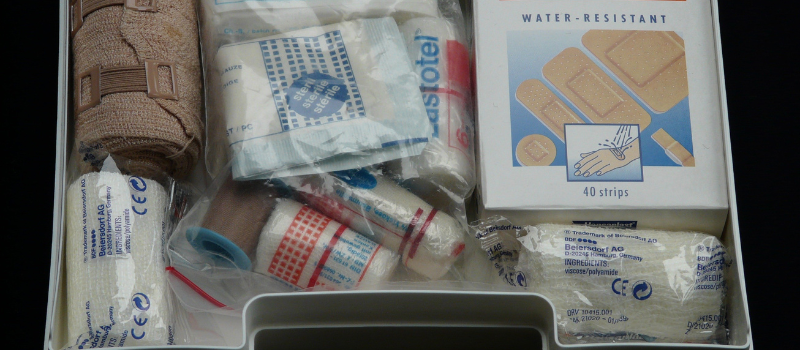
OSHA First Aid Kit Checklist
The following OSHA first aid kit checklist can help employers review their supplies. It is not a mandatory inventory for every workplace. Quantities and added equipment should reflect the workforce, site layout, hazards, and injury history.
A workplace first aid kit may include:
- Adhesive bandages
- Adhesive tape
- Antibiotic applications
- Antiseptic applications
- Sterile pads
- Trauma pads
- Roller bandages
- Triangular bandages
- Absorbent compresses
- Burn dressings
- Burn treatment applications
- Cold packs
- Eye coverings
- Eye and skin wash
- Medical exam gloves
- Hand sanitizer
- A breathing barrier
- Scissors
- A foil blanket
- A first aid guide
You can print or save this checklist for workplace or jobsite inspections. Add supplies for injuries that have occurred at the site or could reasonably happen there.
How Often Should Workplace First Aid Kits Be Inspected?
OSHA requires construction first aid kits to be checked before they are sent to a job and at least weekly while at the jobsite. OSHA does not set the same weekly schedule for general industry. Those employers still have to keep their kits stocked and ready for use.
The International Safety Equipment Association recommends inspecting workplace first aid kits at least monthly and after supplies are used. A busy warehouse or production facility may need to check them more often.
During each inspection, confirm that:
- The date, inspector’s name, and kit location are documented
- Used, missing, or depleted supplies have been replaced
- Expired, contaminated, or damaged products have been removed
- Individual packages remain sealed
- Product labels are readable
- Employees can reach the kit quickly
- The supplies still match current workplace hazards
- Restocking has been documented
Pay attention to kits stored in vehicles, outdoor work areas, or hot warehouses. Heat, moisture, and rough handling can damage supplies before their listed expiration dates.
First Aid Training and Emergency Preparedness
Both the general industry and construction standards require trained first aid personnel when professional medical care is not close enough to treat an injured employee promptly.
Employers should evaluate how quickly professional medical care can reach the workplace based on the site’s location and the hazards employees face. If prompt treatment is not reasonably available, trained first aid personnel must be available.
An OSHA first aid training and safety program can document who will respond, where supplies are stored, how incidents are reported, and when employees must call emergency services.
First aid procedures can also be included in broader safety program development. Supervisors and safety personnel who need more instruction on general industry standards may benefit from OSHA 10-hour general industry training.
Facilities and projects with higher medical risks may also need dedicated EMT, paramedic, or medic personnel on-site.
Review Your Workplace First Aid Program
Safety by Design helps construction companies, industrial facilities, warehouses, and other employers review first aid procedures, train employees, and prepare for workplace medical emergencies. Contact our team to review your program or schedule workplace First Aid, CPR, and AED training.

Thank you for visiting our website! We appreciate your interest in workplace safety. Please note that Safety by Design is not affiliated with OSHA. However, we can assist you with the following OSHA-related services:
- OSHA Mock Inspection
- OSHA Training
- Facilitate OSHA Inspections and Citations
If you need to file a complaint with OSHA, please call 800-321-6742 (OSHA) or visit this page for other methods to contact them.